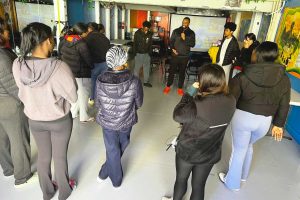



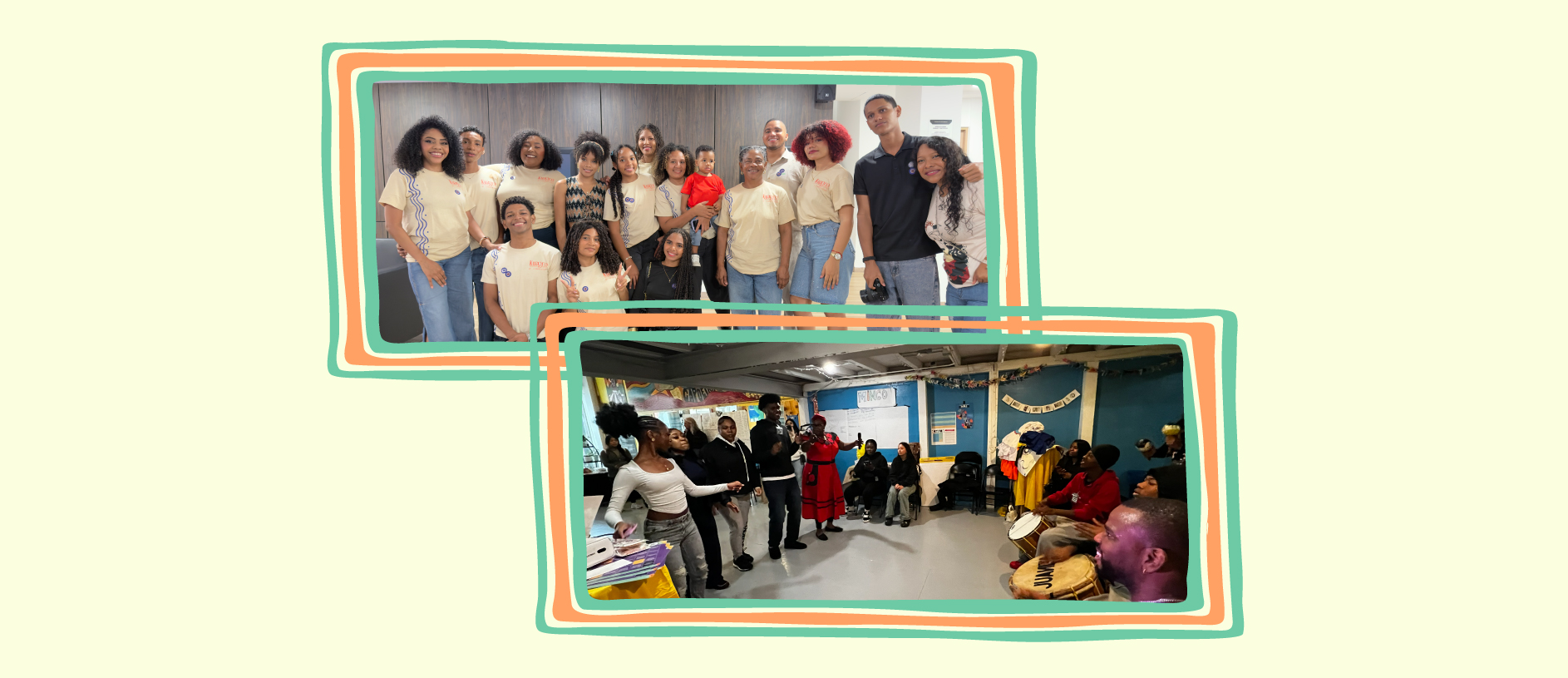
On February 11, 2026, we held a gathering between young members of the Communications Kuagro of the Afro Mata ‘e Pelo Foundation in La Guajira, Colombia, and participants from the “Conectandonos MAS ” Cohort 2026, a youth leadership program of Movimiento Afrolatino Seattle (MÁS).
Las y los participantes de MÁS hacen parte de un proceso de formación para convertirse en jóvenes líderes de la cohorte 2026, fortaleciendo su conexión con las raíces ancestrales y las contribuciones afrodescendientes en América Latina.
It was a space for young people, by young people. A horizontal dialogue where lived experience was the starting point.
In the conversation, a common recognition emerged: inhabiting an Afro body means navigating everyday scenarios where racism operates structurally. At school, at work, in leisure spaces, in daily interactions. Questions about aesthetics, accent, language, or racial affiliation are not isolated incidents; These are expressions of a colonial matrix that continues to organize hierarchies.
Naming this is a reflective and political act; it is understanding that our experiences are not only individual, but also collective and structural. But it was also a space to recognize the other dimension of inhabiting the Afro body: pride, creativity, spirituality, dance, traditional medicine, cuisine, and the production of our own knowledge. The diaspora not only resists: it creates, connects, and transforms.
One of the most powerful lessons of the gathering was the importance of teamwork. Both in Kuagro de Comunicaciones—conceived as a community, political, and cultural space where identity is strengthened through anti-racist communication—and in “Connecting MORE,” leadership is understood as service to the group, not as hierarchy.
We spoke of efficient and collective leadership: recognizing the talents and values of each member, distributing responsibilities, trusting in the team’s capabilities, and building from a horizontal structure. Something fundamental also emerged: allowing oneself to make mistakes. In creative and organizational processes, mistakes are not failures; they are learning experiences. From a decolonial perspective, unlearning punitive and competitive logics is part of building new ways of leading.
For the Kuagro communications team of the Afro Mata ‘e Pelo Foundation, audiovisual creation occupies a strategic place on this path. Telling our stories from our own perspective is not just an aesthetic choice, it is a political stance. Communicating from an anti-racist perspective means reflecting before publishing: From what perspective are we speaking? Whom do we represent? What narratives are we reproducing or dismantling?
Audiovisual media allows us to look at ourselves, recognize ourselves, and show ourselves to the world without asking permission. It allows us to record our positive experiences, our cultural practices, and our organizational processes, expanding the reference points for other Afro youth in the diaspora.
This gathering confirmed that the diaspora is a living network of connection. Beyond borders, we share structures of oppression, but also knowledge, spiritualities, and ways of building community.
When young Afro-descendants come together to dialogue, reflect, and create knowledge based on their experiences, they don’t just analyze reality: they transform it.
And they do so as a team, with collective leadership and the conviction that we don’t need permission to be who we are.